Friday, 5 July 2013

#355: Retirees at Play

Aaaaagh!  For all the world knows, I am permanently stranded in a stairwell in London because it has taken so long to complete my account of our UK trip!  And it is not as if I am trying to compose a travelogue or download a million pictures.  

It is just that things get in the way.  Volunteering makes demands.  The garden wants attention.   And we occasionally give in to a spontaneous impulse and attend a play in Stratford. 

We were not alone either.  On Wednesday when Bruce and I took in a wonderful matinee performance of Fiddler on the Roof, we had plenty of retired company.  It was a full house with an all-ages audience, but there were loads of grey-haired attendees.  (I concluded that some of these older and younger folks were together: grandma and gramps giving the kids and grandkids a cultural outing.  Perhaps I suspect this because it is what I can imagine us doing in a few years.)     

The seniors-love-Stratford thing was also evident when we had dinner afterwards at a favourite restaurant, The Parlour.  Carpeted floors, comfortable seating, and wasn't that Faure's Pavane tinkling in the background?  How very grown -up! And how appealing to the older folk we noted among our fellow diners.  We were really at The Parlour for their pavlova, but it was still a relief that there was no assertive hip vibe (the attitude, not the body-part) to remind us of our essential un-hipness. 

Yup.  Stratford knows its audience.  Even as we drove into town we had been greeted by an age-- appropriate message on one of those "thought for the day" displays outside a local Inn:
  Time is a great healer but a lousy beautician.  

I am capable of more than one act of summer spontaneity. I should take another look at that Stratford playbill....

Thursday, 13 June 2013

#354: Back to the Blog (and into the Fog)

Hmmm.  What do we have here?
Possibly the best thing about retirement is the freedom to travel, and that is what we were doing the last two weeks in May. 

Can you tell where we went?

I'll post a few more pictures and a bit of commentary into my travel blog, The Reluctant Retiree Abroad.  Off to London...


Friday, 10 May 2013

#353: Live Longer: Volunteer

In Canada, National Volunteer Month is observed in April, but this year instead of planning a bang-up appreciation party for volunteers, I got to attend one. 

In truth, I could have gone to three events at the retirement home where I am the "visiting librarian" because volunteer coordinator Kim had planned a week's worth of activities: a Saturday morning breakfast, a Thursday games night, and a garden tea on Tuesday, the day I am always on the job.  That clinched it --teatime would be my time.

Volunteers of all ages help out at the home so it made sense to me that working folk might choose the weekend breakfast, and younger volunteers would turn up in the evening to play A Minute to Win It.  But on a weekday afternoon?  I should not have been surprised to find that a heap of other retirees were there to have a drink, eat cookies, and plant a red maple (because "volunteers grow community".)

What I didn't expect were volunteer guests who were, in fact, residents of the retirement home.  I sat with Gladys who runs the canteen every Tuesday afternoon, and Evelyn whom I last saw arranging numerous table decorations for Easter dinner.  Mary and Joy were there, too.  I first met them while they were serving eggnog and gingerbread in the foyer at Christmas time.  Having seen the promotional posters for this seasonal gathering,  I was sure that the staff had specifically enlisted these hosts just for the fun of proclaiming Celebrate Christmas with Mary and Joy!  But on Valentine's Day, the two ladies were back with lemonade and sugar cookies, and I figured it out:  Mary and Joy had a regular volunteer commitment just like I did.  And who's to say you can't have a little Valentine's merriment (and joy)?

The thing is, the average age of the "garden party" guests was well over 85. So perhaps there is some truth to the news items I kept seeing all April: Volunteering Promotes Longevity.   Researchers have noted that those who volunteer outlive those who don't, providing that the volunteer activity is genuinely satisfying and enjoyable.  Jumping onto the Meals on Wheels bandwagon just to experience the promised "volunteer high" would not be the best choice, for example, if one gags at the prospect of driving through traffic with a back seat full of insul-packed dinners. (All the fun of pizza delivery, as far as I am concerned, but without the tips.)  I recently extricated myself from a volunteer activity that was entirely conducted by email.  The social rewards of volunteering are important to me, and I already have a close personal relationship with my computer.  I did not need to enhance it.

I'd like to believe this longevity research, especially since I do find my visiting library volunteering socially and intellectually satisfying.  But I would be interested to know how a commitment to volunteering compares to a commitment to work, or to friends and family.  I am willing to bet that older non-volunteers who are still employed, or helping with grandkids or aged relatives, also experience feelings of happiness and fulfillment because they know that what they are doing is important, enjoyable, and appreciated.  Perhaps the real secret to longevity is to feel useful, whether choosing audio-books for a woman recovering from surgery or looking after the grand children every Wednesday.

On my library rounds that week I broached this topic with "Libby", a library client who uses a walker and receives extended (nursing) care.  "I still volunteer", she tells me.  "I take the lady across the hall downstairs to Hymn Sing every Sunday.  Otherwise she forgets to go"  Libby pauses and then adds, "The hymns are terrible, just terrible-- so childish!  But my neighbour loves to attend, and taking her down there doesn't do me any harm."

Libby is 94.  She is optimistic, bright, a prodigious letter writer and a voracious reader.  She particularly enjoys Anne Perry mysteries but keeps her reading in check with a timer which she usually sets for one hour.  "Otherwise, she explains, "I would never get anything else done!"

She also recently passed a "fitness assessment" with flying colours.  When I ask what was required, she explains and demonstrates:  walking, getting out of a chair, picking something off the floor, putting on socks, and raising her arms over her head.  (I can't help it.  I test myself on these tasks in the stairwell as I leave Assisted Care.)

So there we have it: living proof.  Volunteer.  It can't do us any harm.      


Saturday, 27 April 2013

#352: The Last Giraffe: a Knitted Tale/Tail

The horrible truth about intarsia knitting was revealed when Bruce and I went on our cross-country, friends-and-family road trip last summer. I had packed wool in four colours, needles, and the giraffe pullover pattern.  A pumped-up, grandma-in-waiting, I was pretty sure that if I knitted in the evenings (in motels) and in the car (as a passenger) during the daytime, I would be returning to Guelph after five weeks with an adorable finished garment, all ready for the new baby.

Or perhaps not.

Dorothy, my mother-in-law (and Goddess of Intarsia), must have been appalled as she looked down from her heavenly rocking chair at Nancy the naive knitter.  She would have recognized that I was lacking in so many skills that would have made pattern-knitting easier. I was unable to finesse the many strands of wool necessary to create the pattern.  I got lost trying to follow the instructions.  I couldn't count the stitches accurately. And I was far too distractable.  Did I really think I could simultaneously count Nevada roadside prisons and the correct number of stitches for a good-looking little yellow tail?

In fact, I briefly toyed with the idea of re-defining "correct".  Bruce, who watched me knit and rip and curse, and re-knit legs and spots and tail from Canada to California and back, actually encouraged me to fudge a little.   "What is the correct appearance for a tail?"  he argued.  "Why can't a spot be fatter or thinner?"  And I did briefly try to incorporate my mistakes into the body of the giraffe.  But it didn't look right.  And it didn't feel right either. I didn't want to pretend that my errors were deliberate. And I knew it wouldn't work, anyway: I would know. I recalled that my mother (a knitting dabbler, unlike Dorothy) once attempted one of those intarsia-knitted cutsie-sweaters for me.  The pattern showed two large, white geese on a navy background.  When she had completed the sweater, she passed it to me, looked at it, and then took it back.  "I can't give this to you", she said.  "I've forgotten a goose."

I returned from our trip last September with a completed sweater-back, the first few rows of the front, and many, many ragged little skeins of wool that had been knitted, torn out, and re-knitted in my 20-or-so attempts at the giraffe.  I needed a break, and the giraffe must have been exhausted too;  I put us both out of our misery and stuffed my unsuccessful effort into my workbasket.  I knitted a tiny, pattern-free sweater for my grandchild-to-be.  I forgot about the impossible pullover.

Gaaaagh.  The back side of a patterned sweater is scary.

Then, months later, I got an email from my friend Sandra.  There she was, gamely knitting an entire patterned baby blanket (and fixing her mistakes) with her arthritic fingers wrapped in paper tape.  Her grandson was yet unborn, but she already loved him that much.  

I thought of Baby Erik.  At five months he is so sweet, and he would look adorable wearing the giraffe sweater. So I got it out for the 21st time, and I resolved to pay attention and knit like Dorothy. I obsessively counted rows and recorded them.  I turned off the TV when I was knitting the tricky tail. Soon I had a giraffe-shape that looked passably like the pattern, and even though the sweater front is not quite complete, I am confidently near the finish line.  I am quite certain that this really is the last giraffe.
I can see it! A giraffe!

And on my way to rudimentary intarsia competence, I have learned a thing or two:  knitting is not just about technique.  It is, like so many things, about learning, and re-doing, going back, and trying to get it right eventually.  It is about doing your best, even if you fall short.

And when a grandmother knits, it is certainly about love.


Sunday, 21 April 2013

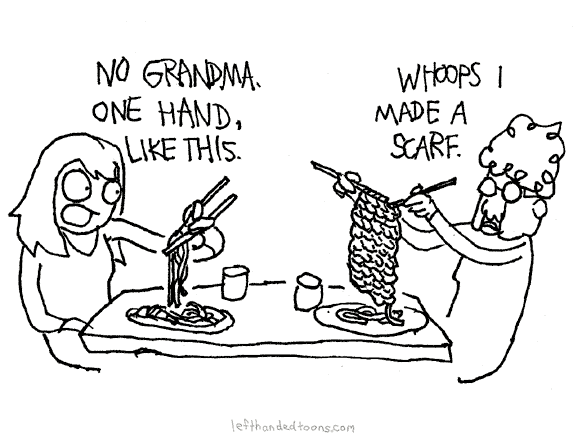
#351: Grandmothers Knit

Thanks to lefthandedtoons.com!
While I disagree with many of the "granny" stereotypes, the one about knitting holds true.  A lot of retired women knit.  Some have been knitters their entire lives, others take up knitting as a late-life hobby and some (like me) rediscover this relaxing, creative activity after a long non-knitting hiatus.   

OK.  I made up the "relaxing, creative" part.

When I knit I am somewhat creative, but never relaxed, because something always goes wrong.  I am forever fixing mistakes, and I am not the only one.  My friend Sandra recently admitted that she was not very far along with the baby blanket intended for her new grandchild, when a major pattern error was detected. It took her three hours to work back to the offending row and re-knit it.  She had to un-knit (reverse) over 800 complicated stitches, one by one by one by one by one......you get the idea.

But if knitting is so much work, why do older women do it?   They knit for people they love, of course, but it is clear to me that they also knit because they have the time. They have the time to un-knit, unravel, and start all over again. They have the time to learn,   And this is especially true for older, novice knitters,  We know that knitting even a simple washcloth or a scarf presents wooly challenges with every stitch.  The struggle to "get it right" is nothing if not time-consuming.

So last summer, when I went shopping at All Strung Out, why did I think I could quickly whip up a pullover sweater for my first grandchild, expected in November?  A patterned pullover, no less.  A giraffe pattern. I must have been pumped up by grandmotherly endorphins, the same rush of affection that no doubt prompted Sandra to say yes to that baby blanket in spite of her severely arthritic fingers. We both must have been thrilled at the prospect of the new babies. That is the only way I can explain my confidence.  "Of course I can knit a patterned sweater with four little legs, a tail, spots and ears.  No problem!"  I told myself as I chose cheerful giraffe colours. That I had no experience knitting even the simplest picture-pattern did not feature in my decision at all.   

Soon I was watching YouTube as a skilled knitter demonstrated how to knit a red heart into the middle of white square.  I learned the word "intarsia".  And I began to suspect that my giraffe project would be the knitting equivalent of hiking up Kilimanjaro.  

When considered the possible difficulties, I began asking my knitting friends about this technique of creating an inlaid pattern in wool.  Do this: ask the knitters you know.  They will be impressed by your vocabulary, and you will discover, as I did, that workbaskets the world over hold unfinished intarsia projects.  Ducks.  Boats.  A Merry Go Round! (Now there was a confident knitter.  She told me that the pattern drove her crazy. She ripped it out twice, gave up, and made a striped sweater instead.)

But how hard could it be?  Really?  Once upon a time, patterned sweaters were all the rage, and plenty of them were hand-knitted.  Remember Bill Cosby and his TV wardrobe of colourful sweaters created by New Zealanders?  Or Mary Maxim sweaters, with their iconic masculine designs?  County-cute sweaters featuring apple trees, barns and farm animals?  If we were lucky, a grandmother knit up one of these beauties for us or our children.  Back in 1988, it never crossed my mind that my mother-in-law Dorothy might have found it difficult to knit a "country house" sweater for me, or a "frolicking sheep" sweater for one of my daughters.  Oh, Dorothy, please forgive me.  I had no idea. 

My struggle to learn intarsia has, indeed, been so monumental that I missed the November deadline and finally put the giraffe out to pasture.  Just for a bit. The sweater is for a year-old baby, after all, so in theory I still have time to finish it.  If I choose to accept the challenge once more, I will have 7 months to figure it out, pattern and all.

Sigh. Let the knitting begin. Again.

Now that I am committed once more to the patterned pullover, I am filled with admiration for my mother-in-law and the sheep sweater.  I recently examined it, and marveled at its complicated design.  It is a beautiful sweater with an intricate, bobbled, sheep-surface.  That pattern could have come with a warning: Experienced Knitters Only.  But the sweater is not perfect.  When I look at the sleeves, I can see that they are not identical: there is a missing row of decorative triangles. *Gasp*  Did Dorothy know? I don't think so. Had she noticed that little mistake, she would have felt compelled to rip out the entire arm and begin again--a knitter's nightmare.
Dorothy's beautiful, imperfect sweater

As I prepare to wrestle with my giraffe, I am glad to consider Dorothy's sleeve.  It is a reminder of how much time, and work and love is expended on a small thing like a child's sweater.  It makes me feel connected to her, and a whole host of optimistic, knitting grandmothers. 

I picture my sweet grand baby.  I mentally dress him in the cosy green, yellow and brown pullover. I can knit this. I have the time.  I'll just channel Dorothy, and start all over again with the four little legs.


Thursday, 11 April 2013

#350: To e or Not To e

Now that we have decided grandmothers (and all older people) are perfectly capable of using e-readers, I'm wondering why more of us don't own them.  Their many advantages make them perfect for older book-lovers. 

E-readers and tablets are:
Lightweight.  I've just finished the hard-bound copy of Stephen King's 11/22/63, and at almost 900 pages this tome gave new meaning to the phrase "heavy reading". I could have also read the equally massive London by Edward Rutherfurd (preparation for my up-coming trip) as a "real" book but have opted for the Kindle edition.

London:  all the words, but none of the weight.
London:  900 pages


Compact.  Every e-reader or tablet is different, but most are the size of a very skinny hardcover. Or perhaps the cover without the book. Nine hundred pages of London will slip into my purse or suitcase with ease. 

Dark adapted.  Some e-readers and all tablets have lighted screens--great for airplanes and half-lit bedrooms.

Font-friendly.  Regular print is usually fine for me.  But my 83 year-old client Hetty is using a Kobo from the library, and she is happy to ramp up the print size. Reading a large-print story on an e-reader doesn't make you look vision-impaired -- just cool.

Capacious.  I have a suitcase full of books, including London, on my Kindle and that is enough for me. But if I get desperate, I have room for at least 2,000 more.

And, in addition, the e-contents-- the books-- are:
Inexpensive.  Overdrive downloads from the public library are free, and may other sites such as Project Gutenberg offer free older titles.  If you buy an e-book, the price varies: some are as much as $20,  but most are comparable to a paperback.  (My London e-book was $10.00.) 

Forever.  Overdrive books disappear from your e-reader or tablet after 3 weeks.  (No fines, no book!)  But books that you buy are yours until you choose to delete them.  This is great for slow readers -- like me.

Disposable.  For many people, throwing out hard-backed books is just slightly less traumatic than euthanizing a pet. But no-one will be calling the public library to have a hand-wringing conversation with a librarian about the resting place of deleted e-books. Easy-come, easy-go. 
  ***

Still not convinced?  I think I know why. If you have an abiding love for real books, it feels a bit cheap and sordid to fool around with a flashy substitute.  And the genuine article has much to love:  I especially appreciate their:

Physicality. It's that tactile thing.  I am seduced by the feel and heft and smell of a bound book. (Although I no longer need to hold a new book in order to breathe in its scent.  I can just cuddle my e-reader and spritz the air with a little Eau de Paperback)

Appearance. Printed books are good-looking.  They have pretty covers and end papers.  They are like a present waiting to be unwrapped.

Shareable-ness.  You can be generous with a real book. You can loan it to a friend and talk about it later.

Permanence. It is hard to love an ephemeral bit of softwear, but a real book has presence.  You can write on the flyleaf or in the margins; you can turn down the corners to mark your place or tuck in the special bookmark a friend gave you.  No-one will ever press flowers between the pages of an e-book. A real book--the Bible, poetry, a cookbook--is a piece of family history.

Power.  I am currently reading a hard-back copy of  The End of Your Life Book Club, a remarkably uplifting homage to reading, family and loss.  The author Will Schwalbe is a book lover, and he makes another point about the physicality of bound books which he expresses beautifully.  He notes that when we encounter books in the spot where we left (and perhaps forgot) them, they demand our attention once again.  He explains:  I often seek electronic books, but they never come after me.  They make me feel, but I cannot feel them.  They are all soul, with no flesh, no texture and no weight.  They can get in your head, but cannot whack you upside it.

Exactly.


Saturday, 6 April 2013

#349: Anti-Ageism

At the e-reader workshop for the techno-curious, I just happened to sit beside Paula, an expressive, enthusiastic woman who was one of my favourite volunteers when I was the library volunteer coordinator.

As we did a quick catch-up, she revealed with great enthusiasm that having just turned 70, she was going back to university to finish a degree. "But it's strange, the reaction I get", she told me. "I met some people from my program last Monday, and they were all so surprised. Completely mystified!  It was like they had never met a really mature student before. They kept saying Why are you doing this at your age?  You are going to school, and you aren't even going to get a job!" 

Still stewing about Overdrive's ageist put-down (#348: Techno-Grannies), I assured Paula that she was doing everyone a favour by returning to university.  She would get her degree, and her fellow students would learn that intellectual curiosity has no age limit.

In fact, I think that Paula has hit upon the best response to ageist slights of all kinds. Positive behaviours that defy expectations about old people are far more productive than grousing and griping about the way others see us.  Take Moses Znaimer's complaint in this month's Zoomer magazine about ageist synonyms for people his age (70): senior/old person/aging boomer/ and most especially, Dear.  He concludes they are all demeaning, although in the process he comes close to declaring himself a "grumpy old man".

The only way to rehabilitate "old" is by expanding the notion of what "older adults" (Moses, that's the best I can do) are capable of.  I can't help but fondly recall my Aunt Anne who took up belly dancing when she was over 80; she liked to perform in tights and leotard at the local retirement home where she (apparently) cheered up a number of grumpy old guys.  I'm not much of a dancer, and I'm through with university, but I'm thinking I should learn to use BitTorrent so I can pirate copies of Game of Thrones, Season 3.  Then I could tweet about it.

Try as we might, however, I'm not sure that ageism will ever, in spite of our best efforts, become as unacceptable as sexism and racism.  It is hard to admit, but while I can unequivocally declare that women and men of all ethnicities are equal in most things, older people really are often slower, and less adept at many tasks. They ask to have things repeated, they can't open those damned pill bottles, and they don't like driving at night.  And as we age, that list of challenges gets longer.

So we can work hard to combat ageism--- and we must--but if we are dissatisfied with the results, we need to get over it and let natural consequences unfold.   Because old folks all know a secret that makes ageist observations about the elderly just a tiny bit easier to tolerate. And here it is: although men will never walk a mile in ladies' stilettos, and white folks are unlikely to wake up some morning in a skin darker than their own, with time--and if they are lucky--everyone gets old.   

Take that, young whippersnappers!